Annalee Davis: 'More Tender Geographies'
September 30, 2026 10:00 AM –5:00 PM
Event Summary
Barbadian artist Annalee Davis’s first solo museum exhibition in the United States, More Tender Geographies, brings together more than thirty works spanning a decade of the artist’s practice. Davis examines what she calls a “post-plantation landscape” through a process by which she looks to land to explore evidence of rupture, care, resistance, and survival. Barbados, a southern Caribbean nation, was first colonized in 1627, then finally gained independence from the United Kingdom in 1966 and became a republic in 2021. Its social and ecological history shapes Davis’s sustained attention to land, labor, and cultural heritage.
On view are works in which Davis incorporates materials found on her family’s property, a working dairy farm that formerly operated as a sugar plantation. Eighteenth- and nineteenth-century pottery sherds likely used by both plantation owners and enslaved laborers are visible in Davis’s (bush) Tea Services, which she has used for distilling teas from local plants, fostering discussions about extraction, disintegration, and ecological devastation on the island.
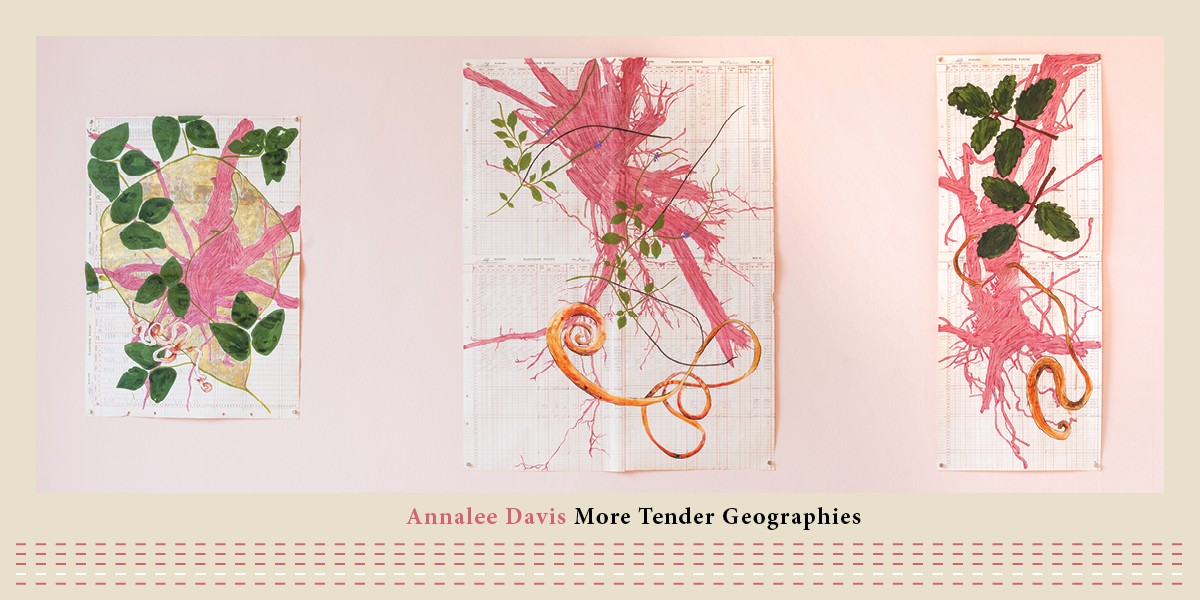
Ledger papers left behind on the property became the substrates in a suite of drawings of plants cultivated in Barbados, such as sugarcane, paw-paw, and blue vervain. The sugar plantation, in Davis’s works, provides a lens through which to reckon with Barbados’s historical reliance on enslaved and indentured labor as well as its environmental impact; monocrop farming has led to a loss of relationship with the land and soil.
Davis also presents a collection of dried plants in How to Know a Land II (2026), a topographic drawing in From a Garden of Hope (2016), and large-scale embroidered textiles, such as Post Reproductive Breasts Sprouting New Life (2024–26). Together these works emphasize plants in the process of healing, care, as well as reproductive and post-reproductive health.
Alongside these works, the exhibition debuts a newly commissioned sound installation created by Davis in collaboration with musicians from Barbados (Simon Pipe & Jomo Slusher) and Martinique (Marcel Jean-Baptiste). In an underground limestone cave, the musicians engaged in a dialogue with the natural world through sound, echo, and reverberation.
Across the exhibition, Davis encourages viewers to recognize mutual entanglements: between past and present, between people, and between humans and the natural world. In ways that are deeply personal yet global in reach, Annalee Davis explores colonial histories of extraction and labor, and the sacredness of land, to unearth possibilities for resistance in the present, while imagining more responsible futures.
This calendar listing is brought to you by Peak Radar, the Pikes Peak region's one-stop, online website for arts and entertainment events, powered by the Cultural Office of the Pikes Peak Region.
Also Occurs On
- Wednesday, September 30
- Thursday, October 1
- Friday, October 2
- Saturday, October 3
- Wednesday, October 7
- Thursday, October 8
- Friday, October 9
- Saturday, October 10
- Wednesday, October 14
- Thursday, October 15
- Friday, October 16
- Saturday, October 17
- Wednesday, October 21
- Thursday, October 22
- Friday, October 23
- Saturday, October 24
- Wednesday, October 28
- Thursday, October 29
- Friday, October 30
- Saturday, October 31
- Wednesday, November 4
- Thursday, November 5
- Friday, November 6
- Saturday, November 7
- Wednesday, November 11
- Thursday, November 12
- Friday, November 13
- Saturday, November 14
- Wednesday, November 18
- Thursday, November 19
- Friday, November 20
- Saturday, November 21
- Wednesday, November 25
- Thursday, November 26
- Friday, November 27
- Saturday, November 28
- Wednesday, December 2
- Thursday, December 3
- Friday, December 4
- Saturday, December 5